The end is closing in for this module, it is time to do some final tweaks and get impressions from other users whos hasn’t seen nor tried the interaction earlier in the process. The key from an observing standpoint is to interfere as little as possible and give the user the bare minimum of information as to what is about to happen and hopefully some valuable insights and feedback can be generated. I couldn’t conduct the test with other students from the course so I referred to a couple of friends.
Here is what they had to say about the interaction with the prototype:
- The LED
Was hard at times to keep focus on it as it is so small. Maybe if the brightness can be increased to easier see it from a far. The same goes with the blinking that it was hard to see behaviour from a distance. The user felt like they had to make an effort to really look at it. Possible solution to this feedback is try up the current or maybe add some kind of physical aid to the LED that could reflect it making it appear to be bigger or easier to see.
- The input action (Users did 3 tests, one sensor each and the final test with both sensors active simultaneously)
Out of the 3 different combinations of sensors, the users felt that the piezo worked the best as it allowed them to do the most natural motion. The LDR felt a bit weird at some times as it didn’t really register the fast movement or the energy the users put in. Other times it would perform just fine. The last test with both sensors combined didn’t provide any more benefit over than just using the piezo element.
- The coupling
Users felt that they could control the interaction in a sense. The output of the LED blinking felt a bit static as the small changes in behaviour wasn’t really showing clear enough. Some users wanted the LED to have a bigger physical appearance or that the light should be more visible so the behaviour could be made out more easily. Almost all of the users felt that the interaction corresponded to the effort they made. From an outside observation I could detect some discrepancy between the coupling. It seemed that the feeling that the LED conveyed (that it is scared) didn’t have the strongest impact on the users. From my perspective it felt more of the arduino/LED worked for the user rather than having a balanced relation.
- Finalization of the prototype
The user testing provided some insightful feedback. I would agree with the general opinion of using only the piezo as the input sensor. It makes more sense to use one sensor that is reliable in its behaviour rather than using two (piezo + LDR) that is a bit unreliable and “confusing” to use.
The physical appearance of the LED have not been an issue for me as I have worked closely with the component for some week now but I felt that it was a issue at the beginning when I started to use it. The appearance of the 3mm LED could surely be augmented by a reflector or something that could reflect the light being emitted, giving the illusion of a larger physical output.
Being efficient with resources is one of the core objectives in sustainable design. I often feel like this is a overlooked part of the design process. Doing the most with the bare minimum should be one of the default approaches when specifying the requirements.
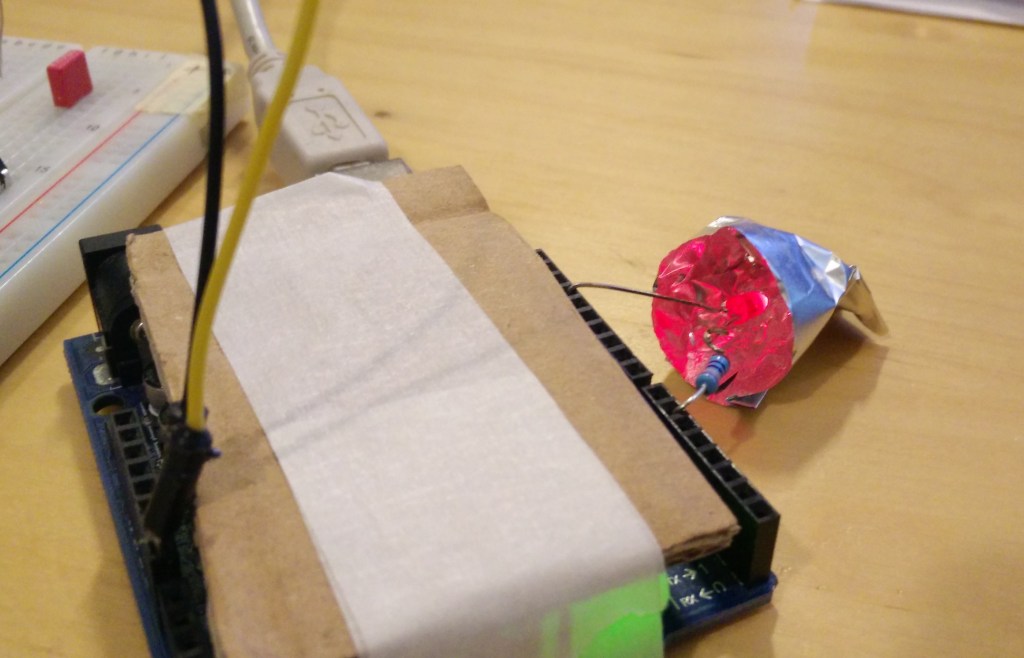
Regarding the feedback, it seems to be inline of what can be expected for these kinds of prototype. The prototype in itself is scaled down and demands attention from the users in order to be correctly experienced. It seemed a bit hard for a non-technical person to really see the benefit or value in the sketch other than school/research purpose. I think its therefore important to discuss the material thoroughly before starting to make clear that the users understand the interaction.

 Micro blogg