The first revision of the interaction with the LED is with a photoresistor. The component is simple in its functionality it has variable resistance depending on the light it receives on its surface. The resistance is either increasing or decreasing depending on the luminosity. The way I thought of using it is easier explained with the sketch below.
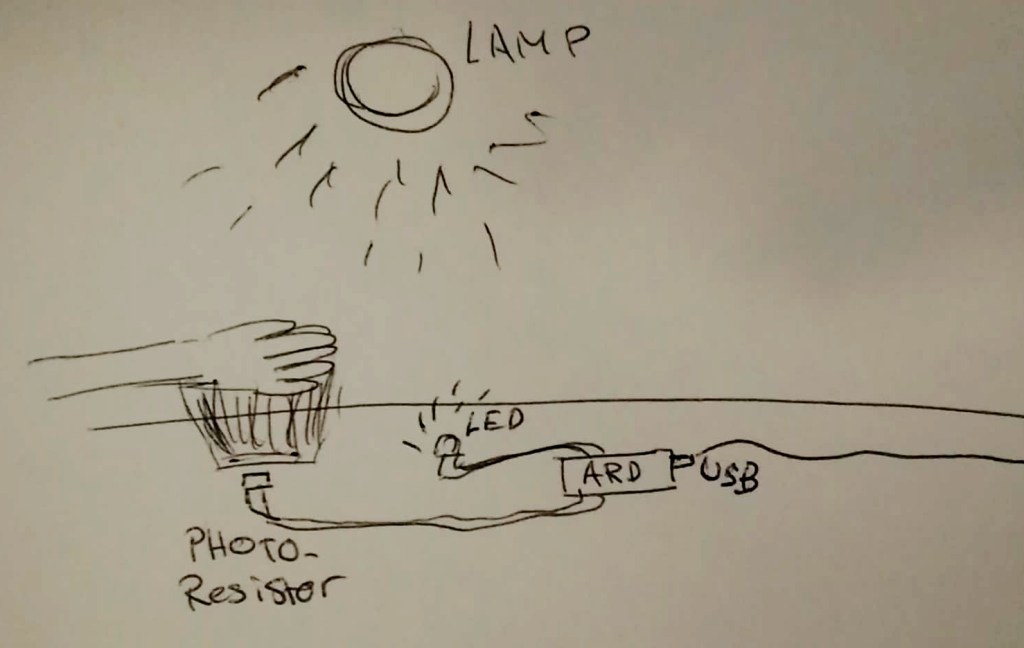
As can be seen in the sketch the point it to do a hasty movement (scare the LED!) above the photoresistor. That movement in turn creates a shadow above the LDR and the resistance will increase. The resistance will be taken as an input by the arduino. Although the LDR is quite dynamic and versatile it think it is hard to be precise with it, at least that is what the early tests with it has shown. Figure 2 shows a graph of how a LDR works. As can be seen it’s not a straight line rather a curve.
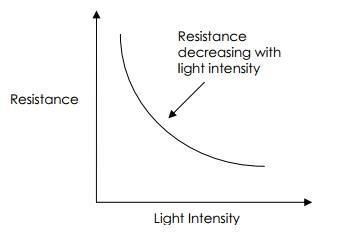
As I only can partially cover the LDR, never completely, I can never reach the highest resistance. I have therefore divided the code to run the LED scared when the resistance reaches half or less than half of its total resistance. The LED will return to a calm state once the resistance is above half or when I remove my hand above LDR. Below are some experiments of with the LDR.
In the video the loop of a calm LED is running and when I come in to scare it with my hand the LED reacts to it. This interaction is done 2 times to show the LED being scared and then realizing there’s no danger and finlay back to what it was doing before the scare. I guess the input interaction doesn’t take into account how fast you come in to scare it, as long as a shadow is made over the LDR. This makes the interaction less nuanced than I had imagined. The LDR is at a point where it triggers if a value is reached, maybe if multiple values can be triggered we can get a more nuanced interaction? What if we can do a quicker hand movement to only cover 20% or something alike?

 Micro blogg