The previous week was all about exploring different patterns without any special inputs. This week’s work is a bit more dynamic. A constraint and an input has to be incorporated. Here I’m thinking of experimenting with a piezo speaker and a photoresistor. Both sensors can provide a dynamic input but I will start with trying out one at a time and figure out what they offer in the interaction. The goal is to make the LED express emotion as we humans can do. The issue is that the LED only communicates to us in a rather simplistic visual way. It can’t communicate with sound which is the main way that we us to communicate with each other. Only when something is too advanced to explain or when there is some kind of language barrier is when visual communication becomes efficient to use. What I’m flagging for is that there might be a discrepancy in the coupling between the input and output of the LED interaction. Crafting a LED to express human emotion can be an enthusiastic goal to reach but we’ll let the experimentation and prototyping lead the way.
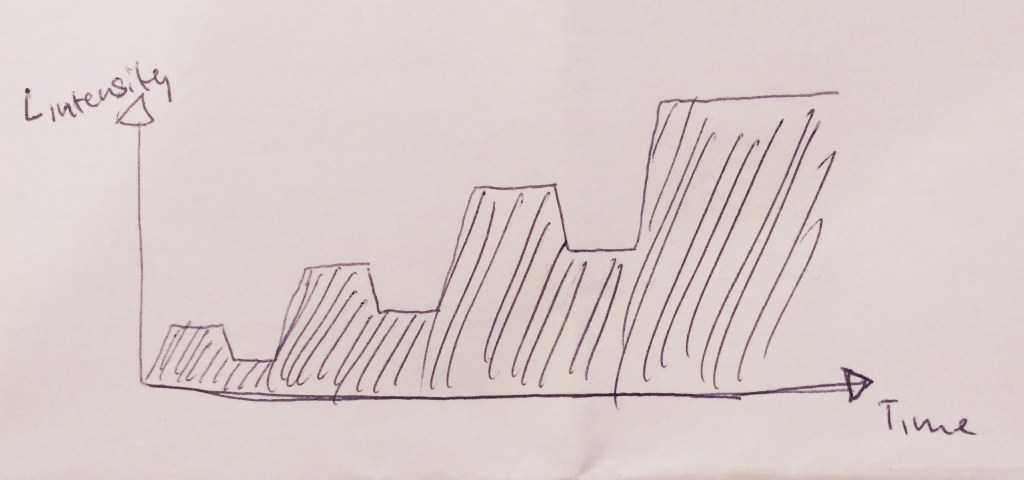
A couple of posts ago I was focused on creating this expression of a data file being uploaded and received. While it is interesting to create and experience the sketch I felt like it was time to move on according to the schedule. Below is an graph from where I left the experiment. I imagine a file transfer being somewhat linear with some minor interruptions along the transfer. The graph would show a gradual build up of intensity until it reaches 100% meaning the file is transferred. What I learnt is that sketching out these graphs of the LED behaviour is really useful to save some some time and to easier envision how the end result is going to be like. Really useful tool in other words.

 Micro blogg