Workshop 3 consisted of a exercise with the arduino microcontroller. The task was to build a interactive keypad/controller for a random game. From the start we thought about some kind of controller where the person has to use the whole body or the balance to control up/down/left/right. But as we split in groups of 2 we downsized our plans to a simple foot pedal which is controlled by pressing with toes and heel.
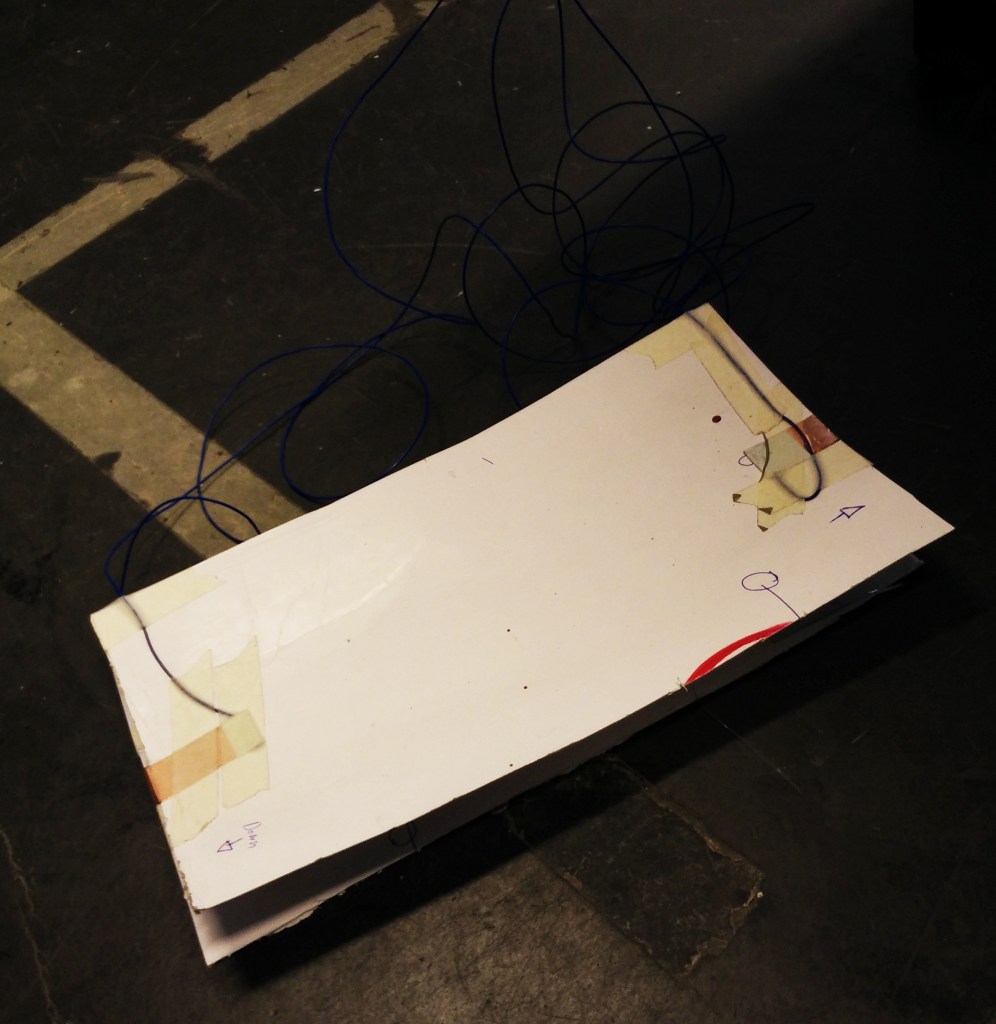
The controller worked barely as intended because it required a lot of force to register a connection. It was calibrated to work with heavier/stronger people. It was cumbersome to use by others who haven´t got the same “pressing power” and still if they had it would not be a viable controller.
The game used to test the controller with, was the classic ping pong game. Although an easy game to understand and play it became hard play with the controller. As the game is fast-paced and requires the player to move the racket up and down on the screen, it gets increasingly frustrated as some level of precision also has to be applied in order to hit the ball.
So, as to help purely interactive with the movement, the pedal does the opposite. Adding frustration, loss in interest and taking away the joyous and fun experience of ping pong. What can be done in order to flip the negative experience of the controller and add (positive) value to ping pong? Maybe the controller can be tuned to be more sensitive and thus reduce the amount of force one has to apply to the pads.
Thinking of the interaction of a fast paced game, to use the hands as a means to control the pad is something that comes naturally to mind as we can do fast and precise movements without thinking to much about it. It someway seems a bit disconnected to use your foot to control something that by nature is controlled by hands. As a conclusion maybe another game that involves the correct interaction to heavy pressing with the foot would be perceived more positive and give good experience.
Matching the prototype to the right end use seems like a obvious thing to do, however we thought about how we could implement different movements in the controller and after that thought about what game to use. So the execution could have been better but I believe we can still salvage the controller by using a more suitable game/interaction.
Not only our group, other groups seemed to struggle with precision in motion as well. Which makes me think about the relation between what’s possible to do with a low-fi prototype and the level of interactivity. Are all low-fi prototypes limited to their assigned (low) interactive value or can it be elevated somehow?

 Micro blogg